How to Level a Washing Machine to Stop Shaking
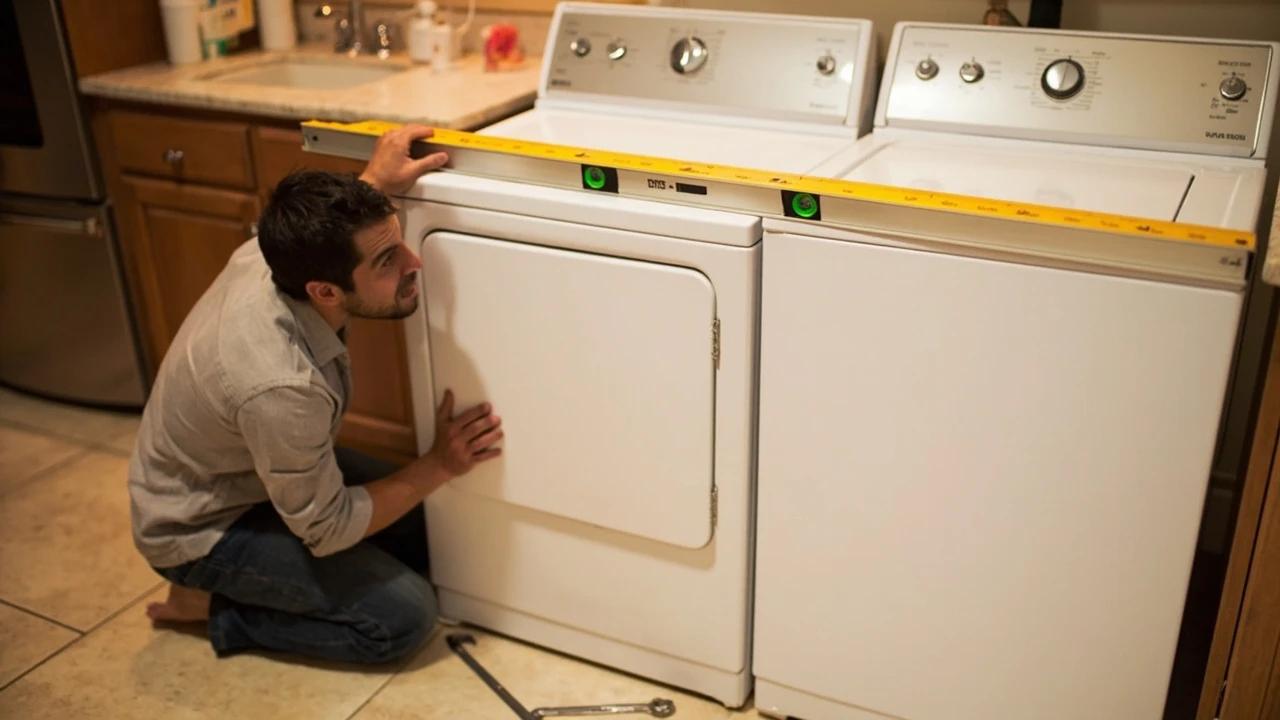

A washer that walks across the laundry room on the spin cycle, hammers the wall behind it, or sounds like a jet engine taking off is almost never broken — it is unlevel, and the drum is throwing the wet load off-axis because the cabinet is rocking on its feet. The fix is a 20-minute job with a $5 bubble level and a pair of pliers (no parts, no service call). Skipping it is genuinely expensive: the constant out-of-balance shaking shortens the life of the bearings, the suspension rods, and the shock absorbers, and a $300 bearing replacement is a real possibility on a washer that runs unlevel for a year. This guide covers both front-loaders and top-loaders, plus the stacked combo unit that vibrates loose every six months.
What You'll Need
🛠 Tools
📦 Materials
Safety First
- •Unplug the washer from the wall outlet before tilting it or reaching underneath. A live 120 V cord plus a damp floor is the most common laundry-room injury, and it is entirely avoidable.
- •Shut off the hot and cold water supply valves behind the washer before pulling it out. If a hose snags on a foot or the dolly, a burst supply line can flood a laundry room in under 30 seconds at full house pressure.
- •Never run a washer on its shipping bolts. New front-loaders ship with 3 or 4 long red bolts in the back that lock the drum for transit; if they are still in place when you run a cycle, the suspension will be destroyed in one load. Remove them and store them with the manual — you will want them back if you ever move.
- •Front-loaders can weigh 200-250 lbs and top-loaders 150-200 lbs. Tilt only with a helper or a proper appliance dolly. A dropped washer crushes toes and tile in equal measure.
Step-by-Step Instructions
Unplug the Washer and Shut Off the Water Supply
Pull the power cord from the wall outlet. Reach behind the machine and turn both the hot and cold supply valves clockwise until they stop — these are usually red and blue handles or a single lever-style mixer valve. You will not be disconnecting the hoses, but if you knock a hose loose while tilting the machine, you want zero pressure behind it. Place an old towel on the floor in front of the washer to kneel on and to catch any drips.
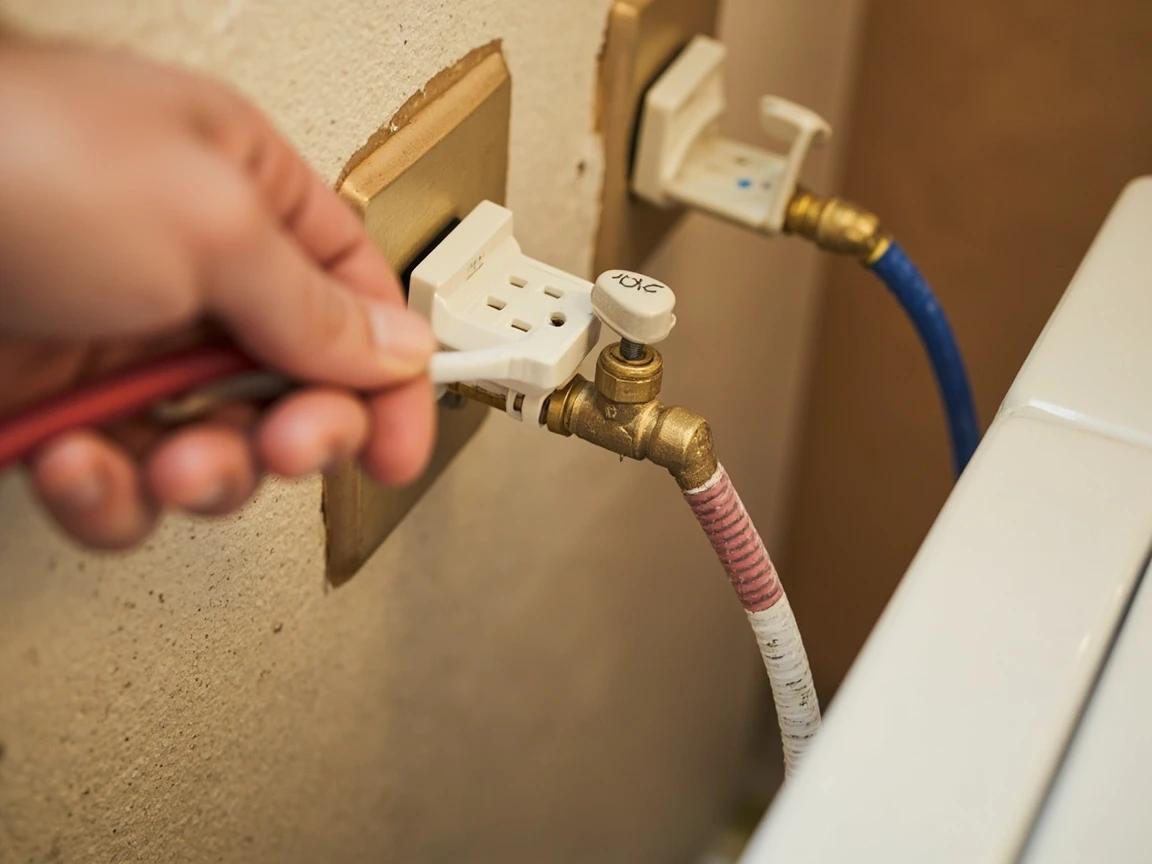
Do not skip the water shutoff just because you are "only adjusting the feet." A snagged supply hose can pop off its compression fitting and dump 5-10 gallons per minute onto your laundry-room floor — exactly the kind of small mistake that ends up as an insurance claim.
Check for Shipping Bolts (Front-Loaders Only)
If your front-loader is less than a year old or you recently moved it, look at the back panel for three or four red-painted bolts (typically 13 mm or 17 mm hex heads) sticking out horizontally. These lock the drum for transit and MUST be removed before any wash cycle. Unscrew them counterclockwise with a wrench or socket, save them in a labeled zip-top bag taped inside the back of the machine, and confirm there are no remaining unlabeled holes. Top-loaders do not have shipping bolts and you can skip to step 3.
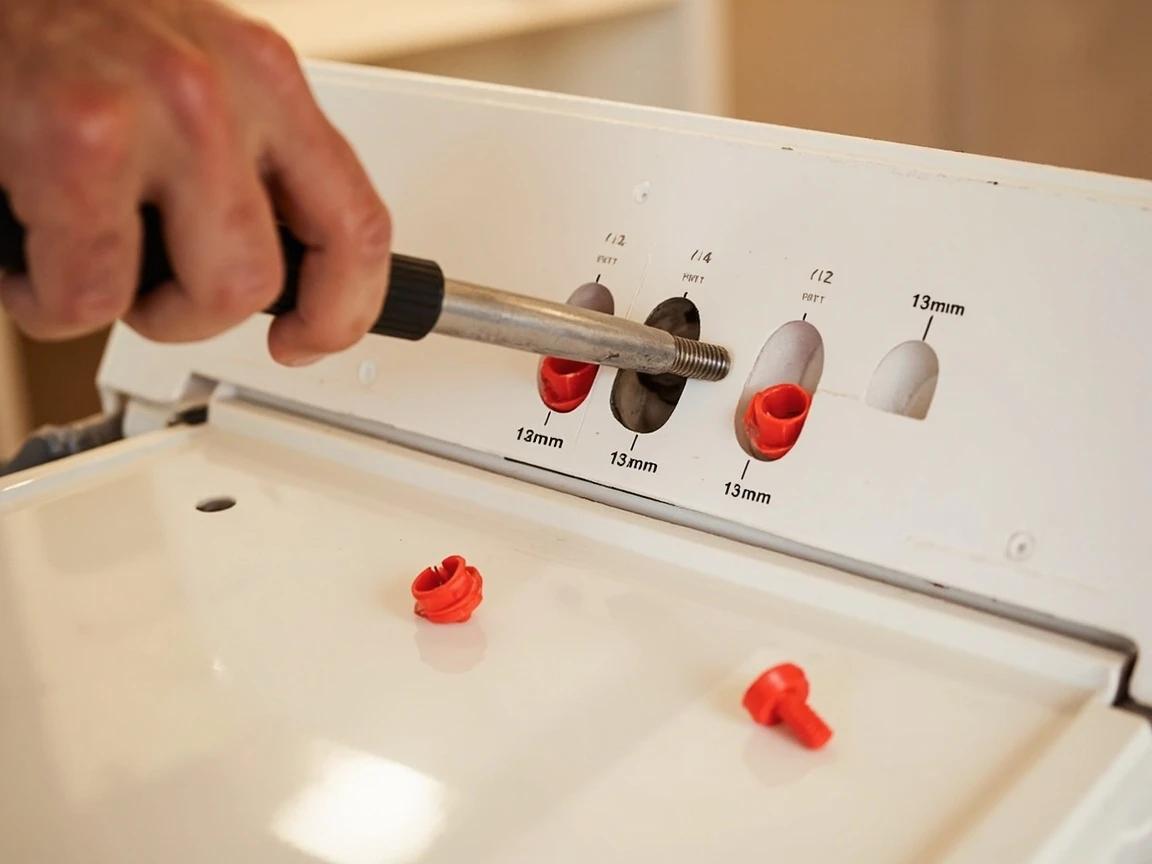
Tape the bag of shipping bolts to the inside of the back panel or to the user manual — you will need them again the next time you move, and a missing bolt at moving time means the drum bangs around inside the cabinet on the truck.
Slide the Washer Out and Place a Bubble Level on Top
With a helper, walk the washer 12-18 inches out from the wall — enough to access all four feet. Set a 24-inch spirit level on top of the cabinet, oriented front-to-back first. Read the bubble: it should be dead centered between the two lines. Now rotate the level 90 degrees so it runs side-to-side and read again. Most unlevel washers are off in BOTH axes — write down (or just remember) which side is high and which is low. The high side is the side you will lower; the low side is the side you will raise.
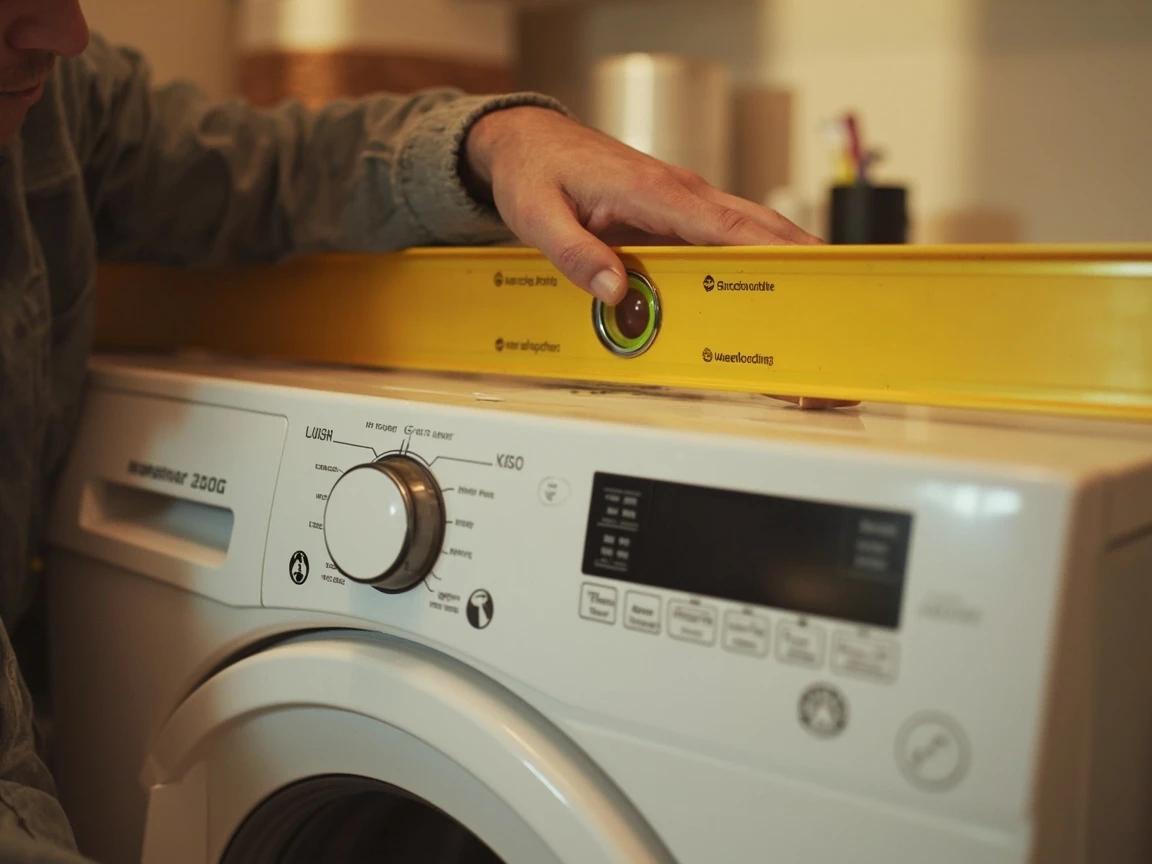
If you do not own a bubble level, the iPhone Measure app has a Level tab built in. Lay the phone flat on the cabinet top and read both numbers; 0.0° in both directions is the target. Any free Android level app does the same thing.
Loosen the Jam Nut on Each Leveling Foot
Get down at floor level with a flashlight. Each of the four feet has a hex-shaped threaded shaft screwing up into the base of the cabinet, and most washers have a jam nut — a thinner hex nut — sitting directly under the cabinet, locking the foot in place. Use an adjustable wrench (or the correct open-end wrench) to turn the jam nut clockwise as viewed from above, which loosens it away from the cabinet. Loosen all four before adjusting any foot — the nuts on a self-leveling rear foot (common on Whirlpool, Maytag, and Samsung top-loaders) may be missing; that is fine, those feet auto-adjust.
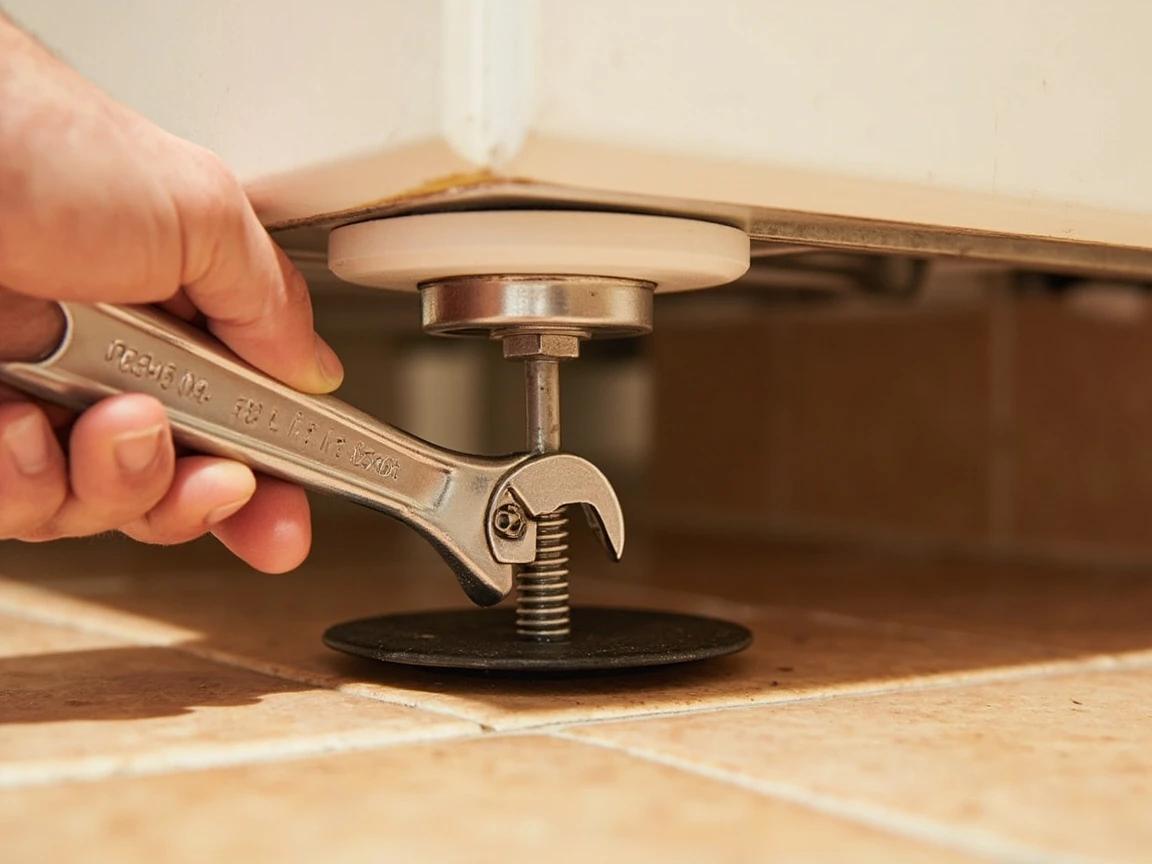
If a jam nut will not budge, hit it with a shot of penetrating oil (WD-40 or PB B'laster) and wait 5 minutes — do not crank harder. Stripping the hex on a 24 mm jam nut means switching to channel locks and clamping down hard, which works but chews up the nut for next time.
Raise the Low Corner by Screwing the Foot Out
Starting with the lowest corner (per your bubble-level reading from step 3), grip the foot itself — not the jam nut — and rotate it counterclockwise as viewed from above. Each full turn lowers the foot relative to the cabinet, raising that corner of the machine. On most washers, half a turn equals roughly 1-2 mm of height change; you will need several turns to fix a noticeable tilt. Stop every few turns, lay the bubble level on top again, and check both axes. The goal is dead-level in both directions simultaneously.
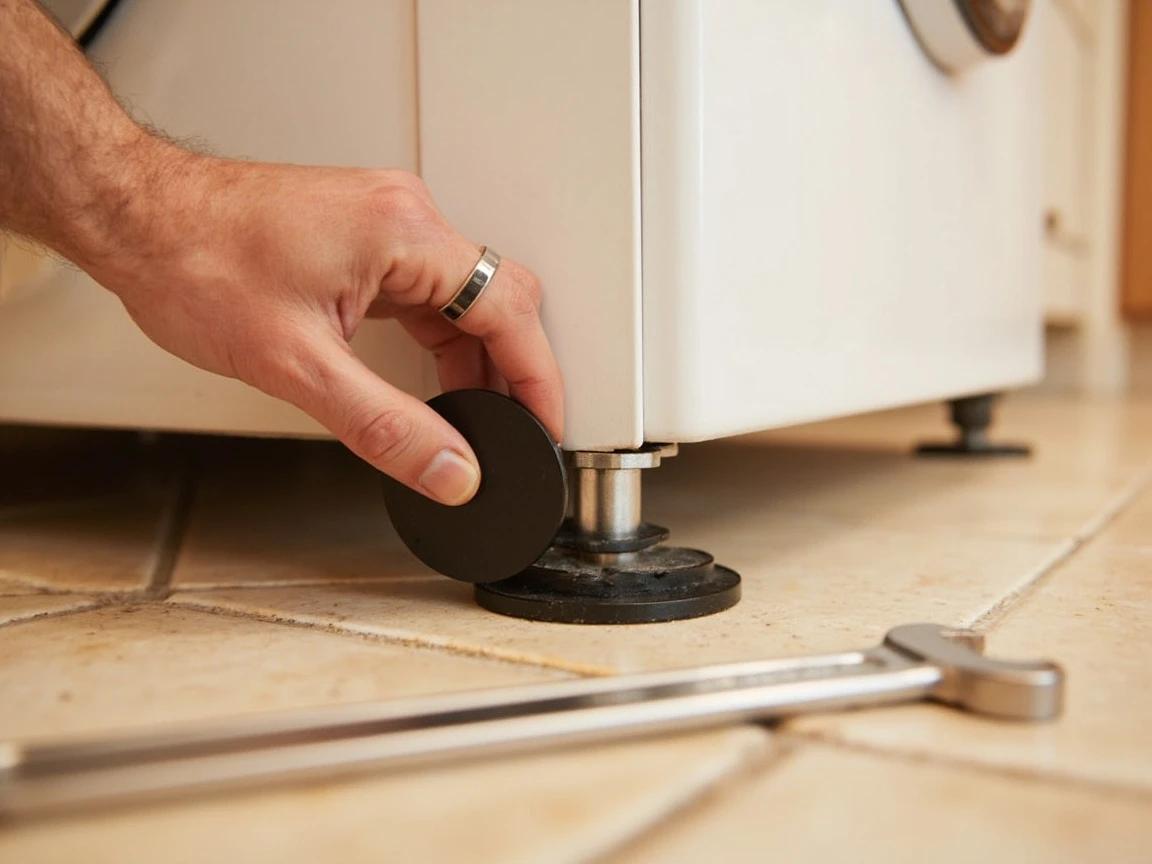
Always raise the low corner rather than lowering the high corner. Lowering a foot too far can lift it off the floor entirely, which is the opposite of what you want — every foot must firmly contact the floor for the cabinet to be stable.
Do the Rock Test on All Four Corners
With the bubble level reading 0.0° in both directions, push down hard with both palms on each of the four top corners of the cabinet in sequence. The cabinet must not move when you press a corner — if it does, that corner's foot is not firmly contacting the floor (or the diagonally opposite foot is too high). Adjust the offending foot down a quarter turn at a time until all four corners pass the rock test. A washer can be perfectly level on the bubble and still rock if one foot is in the air; both tests must pass.
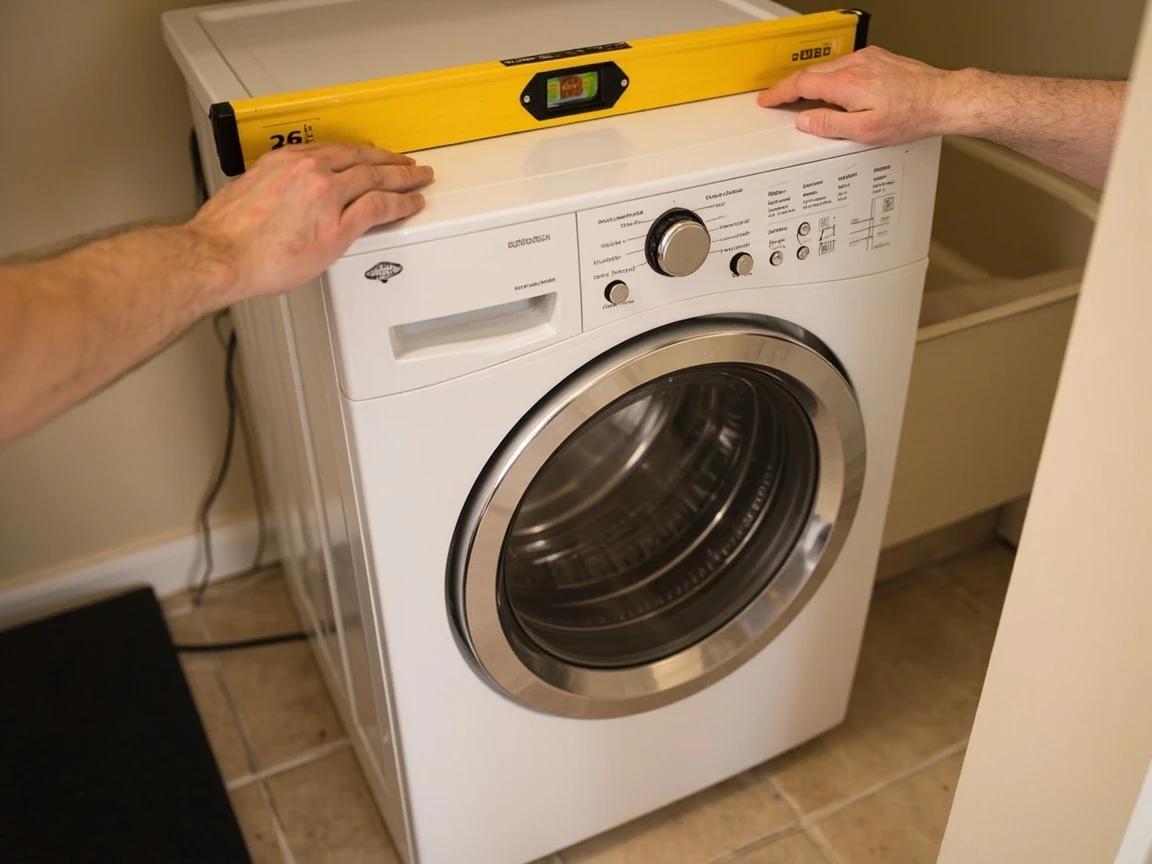
Most homeowners stop after the bubble reads zero, which is why their washers still walk. The rock test catches the one foot that is technically level but in the air — and that one floating foot is what causes 90% of remaining vibration.
Tighten Each Jam Nut Up Against the Cabinet
Now lock everything in place. With the foot held steady (a second wrench or a pair of pliers helps), rotate each jam nut counterclockwise as viewed from above to drive it up firmly against the underside of the cabinet base. Snug it hard — finger-tight is not enough, the constant spin-cycle vibration will back a loose jam nut off in a week. Repeat on all four feet. After tightening, re-check the bubble level on top — sometimes tightening a nut pulls the foot a fraction and re-introduces a small tilt.
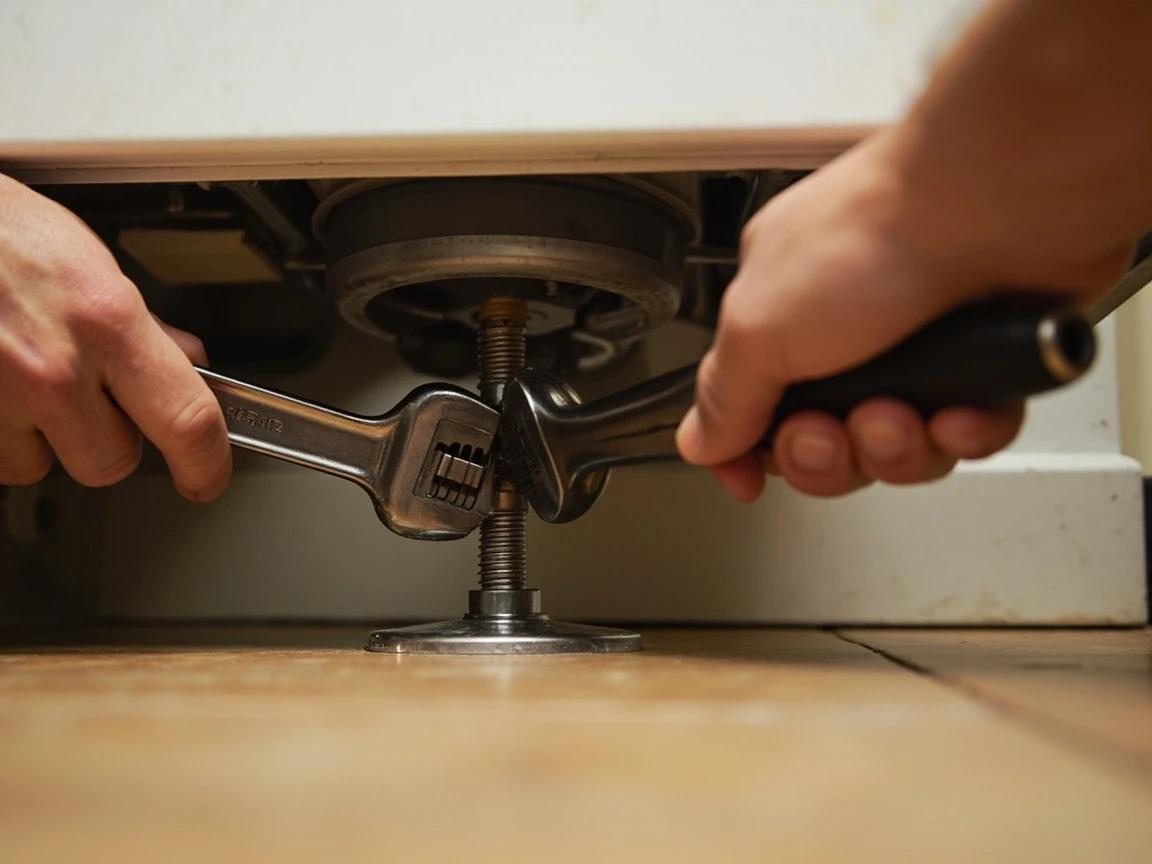
A drop of blue (medium-strength) threadlocker on the jam nut threads is overkill for most homes, but if you have a high-speed front-loader on a wooden second-floor subfloor, it is genuinely worth doing. Red (high-strength) threadlocker is too aggressive — you want to be able to re-level next year.
Slide the Washer Back, Reconnect, and Run a Spin Test
Walk the machine back into position, leaving 1-2 inches of clearance behind for the hoses. Open the supply valves and plug the cord back in. Run a short Rinse & Spin cycle with the drum empty, then with a small balanced load (a few towels). Stand near the machine and watch the cabinet during the high-speed spin — there should be a steady hum and no walking, no banging, and no perceptible side-to-side wobble at the top of the cabinet. If you still see motion, repeat steps 4-7; one foot is almost certainly off.
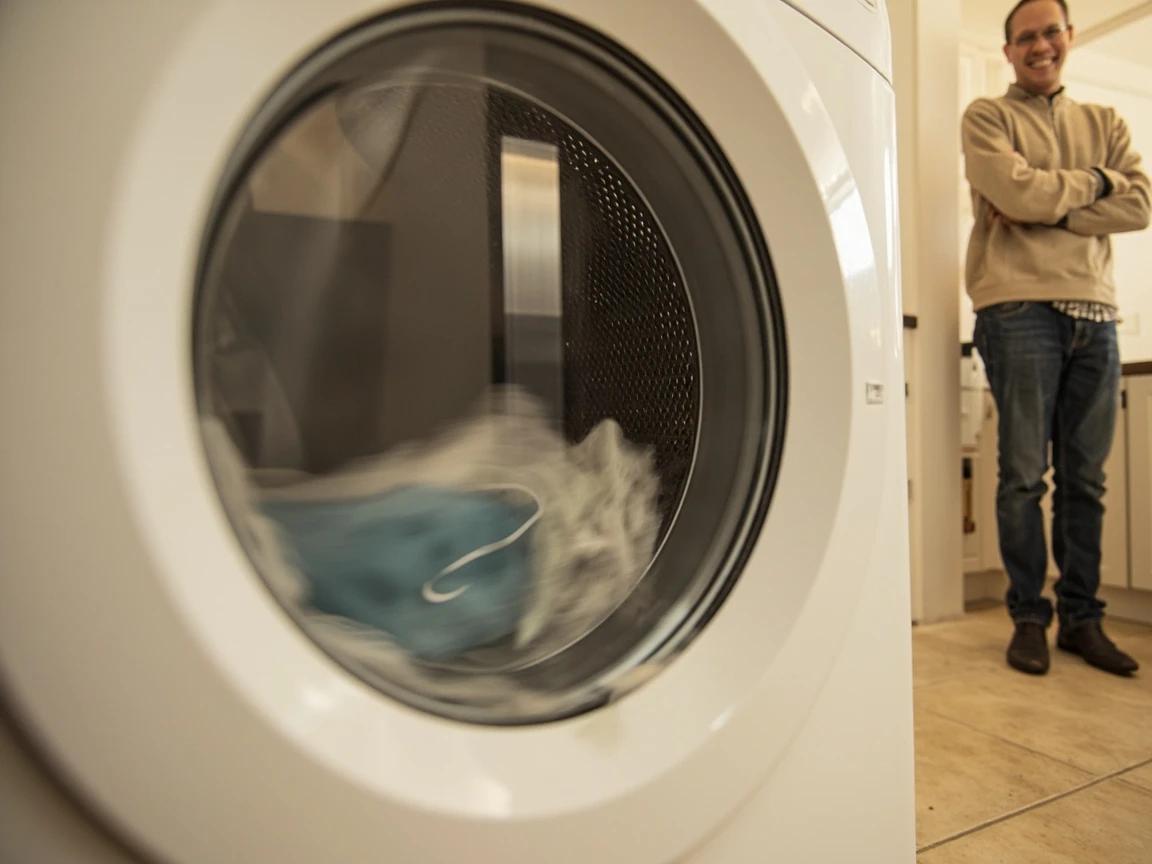
A perfectly level washer is so quiet on spin that you can rest a coin standing on its edge on top of the cabinet through the entire cycle. It is a satisfying test — and an unmistakable sign you got the job right.
Frequently Asked Questions
Why does my washing machine shake so violently on spin?
+
Nine times out of ten the cabinet is unlevel and rocking on one or two feet, which lets the spinning drum throw the wet load off-axis and amplify every wobble. The other common cause on a brand-new front-loader is the shipping bolts — three or four red bolts in the back panel that lock the drum for transit; if they are still in place on the first wash, the suspension will be destroyed in a single cycle. Level the four feet, confirm all shipping bolts are out, and 95% of "broken washer" complaints disappear.
How do I know if my washer is level without a bubble level?
+
Set a full glass of water on top of the machine, centered. If the surface of the water sits visibly off-parallel to the rim of the glass, the machine is unlevel. Better still, download any free smartphone level app (every iPhone has one built into the Measure app, under the Level tab) and lay the phone flat on the cabinet top — the digital readout should show 0.0° in both axes. A real bubble level is more accurate, but a phone gets you within half a degree, which is plenty.
My washer is level but still shakes — what now?
+
Check three things in order. First, the rock test: with the machine off, push down hard on each of the four top corners in turn; if any corner moves while the diagonally opposite corner stays planted, that foot is not contacting the floor and needs to come down. Second, the load: a single heavy item (a soaked rug, a comforter) thrown to one side of the drum will unbalance even a perfectly level washer — redistribute or add towels to balance it. Third, on front-loaders, confirm the shipping bolts are out — even one remaining bolt will shake the cabinet apart.
Should I put anti-vibration pads under my washer?
+
Only after you have leveled the machine, not as a substitute for leveling. Rubber anti-vibration pads ($10-20 for a 4-pack at any home center) reduce noise transmission through a wood subfloor and help on a smooth concrete slab where the steel feet want to skate, but they cannot fix an unlevel cabinet — they just dampen the symptom. Level first; add pads only if the machine still telegraphs noise into the room or slides on a slick floor.
Do front-loaders need to be more level than top-loaders?
+
Yes, much more. A front-loader spins at 1,200-1,600 RPM with the drum on a horizontal axis, so even a half-degree of tilt translates into enormous centrifugal forces at the suspension rods and shock absorbers. Top-loaders spin at 600-800 RPM on a vertical axis and are far more tolerant of minor unevenness. If you only have time to level one appliance perfectly, level the front-loader.
How often should I re-level my washing machine?
+
Check it once a year, and any time you notice new vibration or banging. Wood subfloors flex and settle, the rubber feet on stacking kits compress over time, and the leveling feet themselves can back out of their threads from constant vibration — especially on a heavily used machine. A 60-second bubble-level check during your annual dryer-vent cleaning is the cheapest preventive maintenance in the laundry room.
Sources & further reading
- How to Level a Washer — Whirlpool
- Washing Machine Vibration and Movement — Troubleshooting — LG
- How to Fix a Washing Machine That Vibrates or Shakes — Family Handyman
More Appliance Repair Guides
View all → Medium45 min
How to Fix a Washing Machine That Won't Drain
A washing machine that won't drain leaves you with a tub full of standing water and a pile of soaking clothes — but the fix is almost always a clogged filter, kinked hose, or small object jamming the pump, not a dead motor. Most homeowners can diagnose and resolve the problem in 30-45 minutes with basic tools and no replacement parts. This guide walks through every common cause from simplest to most involved so you can get your washer spinning again.
 Easy1h 15m
How to Clean a Dryer Vent Duct
Clogged dryer vents are the leading cause of home dryer fires and the reason your clothes need two cycles to dry. Cleaning the duct yourself takes about an hour with a $25 rotary brush kit and a shop vacuum, removes years of compacted lint, restores drying efficiency, and lowers your energy bill. This guide walks you through unplugging the dryer, disconnecting the duct, brushing the entire run from end to end, and verifying airflow at the exterior hood.
 Easy25 min
How to Clean a Refrigerator Condenser Coil
Dirty condenser coils are the number-one cause of refrigerator inefficiency — they force the compressor to run longer and harder, driving up your electricity bill by 10-25% and shortening the appliance's lifespan. Cleaning them takes about 20 minutes with a brush and vacuum, and the improvement in cooling performance is immediate. This guide covers locating coils on both bottom-mount and rear-mount models, safe cleaning technique, and a maintenance schedule to keep your fridge running at peak efficiency.
You Might Also Like
 Medium1 hr
How to Repair Scratches in a Hardwood Floor
Scratched hardwood almost never means refinishing the whole floor. This guide shows you how to match the fix to the damage — a touch-up marker for finish-level scratches, a wax fill stick for shallow ones, and stainable wood filler with stain and polyurethane for deep gouges — all for under $40 in supplies and about an hour of work.
 Easy20 min
Best Paint for Kitchen Cabinets, Compared
The four paints that actually hold up to daily kitchen use are Benjamin Moore Advance, Sherwin-Williams Emerald Urethane Trim Enamel, INSL-X Cabinet Coat, and Behr Urethane Alkyd. They all work; they each fail in different ways. This guide compares cure time, leveling, scratch resistance, and price so you pick the one that matches your skill level and timeline — not the one a paint-store clerk has the most stock of.
 Easy25 min
Best Deck Stain: Transparent vs Semi vs Solid
There is no "best" deck stain — there is the right stain for your sun exposure, wood condition, and how often you want to redo the job. Transparent stains last 1-2 years but let the natural grain show. Solid stains last 4-7 years but look like paint. This guide walks the four opacity levels and the oil-vs-water choice so you pick the one that matches your deck and your tolerance for re-staining.